An education dream left in the shadow of an eternal flame

The 50th anniversary of the assassination of John Fitzgerald Kennedy has come and gone…

My fourth-grade teacher, Mrs. Turner, steps out of the classroom for a minute and returns, visibly shaken and distraught, to announce that we will be dismissed to the buses and sent home a little early today because President Kennedy has been killed in Dallas.

The baby boom generation’s first so-called “flashbulb” memory, virtually everyone alive on Nov. 22, 1963, remembers, with almost photographic precision, the moment they heard the news. Indelibly burned into my mind’s eye is the image of my mother, Kleenex in hand, her eyes swollen from an afternoon of weeping in front of the television waiting on every word from Walter Cronkite, then the news anchorman for CBS. Given the vivid nature of the memories, it is difficult to comprehend that half a century separates us from that dark hour of American history.

It is fraught with unintended irony that, this fiftieth year after his loss, the end of American Education Week will coincide with a landmark anniversary of such a deep scar on our national psyche. Is it not worrisome that, in the intervening decades, we have never again focused with such laser-like intensity on achievable national goals such as landing a man on the moon and returning him safely? Is it not disturbing that political agendas now seem most intent on erecting roadblocks and barricades to noble and visionary causes?

My generation, the one called to commit itself to national service and the common good, will forever wonder whether JFK might have inspired this nation to achieve his goal of giving all children “the right to an education to the limit of their ability.”

As we celebrate our educational accomplishments and set our goals for the future, it is abundantly clear that this nation possesses sufficient resources to meet the needs of every child. It is not clear, however, that we will ever muster the political will to render ZIP codes irrelevant to educational opportunity so that we create a world free of the concept of disposable children.

Further Reading @ The Prince George’s Sentinel


[The original of this Commentary appeared in the now defunct Prince George’s Gazette on November 21, 2013. It has been slightly revised for the purpose of rendering more current.]

Read early and often for more successful children

In Broca’s Brain Carl Sagan offered the following wisdom, “We are an intelligent species and the use of our intelligence quite properly gives us pleasure. In this respect the brain is like a muscle. When it is in use we feel very good. Understanding is joyous.”

While our brain has served us well in comprehending the world, only recently have we begun to understand the marvelous machinery of the human brain. In the coming decades understanding its workings will prove invaluable in altering the educational process.

Apparently, the brain is hard at work seeking order in the world much earlier than anyone previously believed. It is now known that a mother’s recorded heartbeat will pacify a distraught newborn while a stranger’s recorded heartbeat does not.

Record the babbling of six-month-old infants in their cribs and anyone with even a rudimentary knowledge of linguistics can likely determine which language is spoken in the ambient culture. The sound production of babies is clearly not random noise. The phonetic system of the surrounding language is unmistakably present in the utterances of infants.

It is clear that the acquisition of spoken language begins almost immediately after, if not prior to, leaving the birth canal.

One method of teaching music to toddlers, the Suzuki method, involves training toddlers and parents, taking the lessons together, to play a musical instrument by ear. Typically, the children enhance their self-esteem as they quickly outpace their parents in the acquisition of musical skills. Brain researchers have recently established that children who start this method at three years of age exhibit an extra lobe on the brain by adolescence. An intellectual stimulus inspires a physical growth response!

Ninety percent of those possessing this extra lobe “acquire” perfect-pitch, or the otherwise rare ability to name any frequency they hear.

We can only wonder if the extra “fold” in Albert Einstein’s parietal lobe grew as a result of his precocious contemplation on the nature of electro-magnetism and the “invisible” force of gravity…

On the other end of the brain-function spectrum are found so-called “feral” children. Across the centuries several children have by unfortunate happenstance arrived at adolescence completely deprived of familial nurturing and social intercourse. Despite decades of remediation, none have learned to communicate anything meaningful by speech beyond the level of the simple mimicry of sounds.

These anecdotes from disparate sources, and others too numerous to be treated here, suggest that there may be finite windows-of-opportunity for optimizing brain function in certain domains. Many of those windows open and close in the years between birth and the current age for starting school.

Do you want to see improved performance in our public schools? Do you want to make the most important investment that can be made in the lives of children? Do you feel the need to do really good works and serve others?

  • Read to children.
  • Read to your children.
  • Read to your grandchildren.
  • Read to your neighbor’s children.

Tell everyone you know to read to every child they know every day for as long as possible. Start conversations with children by asking them what they have read lately.

Start reading to children when they are in the crib. Give infants your “face-time”. Let babies watch you form sounds. Watch them try to mimic the movements of your face. Imitation is the first learning skill. It is how children learn to operate their speech equipment.

Sit beside them and read the newspaper, or even your bills. Play with your voice and make it sound like a story. At that age the meaning is not as important as the stimulation of the sound of your voice.

As they get older start including rhymes…

  • Read to children at your school.
  • Read to children at your pool.
  • Do not let children play the fool!
  • Teach your children that reading’s cool!

Any questions?

As soon as children are willing and able, have them read to you. Make it fun and praise them mightily. Make it a priority to spend a lot more time with, and a little less money on, the children in your life. Shoes and toys will be discarded; memories and knowledge will endure.

Children, like everyone else, do best what they do most. Their future success, like it or not, will likely be determined by how well they read. How well children read will be determined in no small part by the importance the adults in their lives attach to the act of reading. Make sure that children see you reading. Lock the television in the closet and bring it out on special occasions; make books a part of daily life.

Or, television could be used for a higher purpose. Perhaps the Prince George’s County Public Schools could produce a show for cable called Bedtime Stories. It could spotlight a different teacher every night reading a story to a small group of children settling in for a nap. The show could be subtitled, or the text could be displayed on split screen. The teacher would model the behaviors of effective readers. Teachers in the schools could assign it as homework, and perhaps little brothers and sisters would be caught up in the fun.

Perhaps this would help reach into households where the marginal literacy of adult caregivers precludes children from achieving their innate potential.

The intellectual stimuli that induce the reading explosion must occur well prior to registration at school. An introduction to the foundational precursors of reading must occur long before the introduction of a  kindergarten teacher. Preschoolers who lack reading skills arrive way back in the pack at the starting line, unprepared for the race to come, and condemned to more than a decade of trying to gain ground on the more advantaged.

Some years ago a bumper sticker declared, “If you can read this, thank a teacher!” A new message is needed for a more enlightened age. “Help a teacher, read this to your child.”


[ Originally appeared in the now defunct Prince George’s Journal on 07 November 2001. It has been slightly revised for style and readability.]

It’s not nice to fool with Mother Nature, especially in school

Mother Nature is not kind.

The travails and woes of the individual are irrelevant to the remorseless devices of nature. Except for those currently being schooled in Kansas, nature is about the business of improving species through competition for resources in narrow ecological niches. Compete, or be replaced by the more competitive, such is the fate of most living organisms.

Only humankind purports to have improved systematically on this protocol. The horrors of war and indiscriminate violence notwithstanding, humanity claims to cherish the individual. Perhaps it will be our legacy that even those perceived as “weak” were nurtured. Even those that would surely perish in nature contribute, and sometimes mightily, to the common good.

Still, Mother Nature cares not a whit.

Designated wetlands surround my sub-development. There, at least to some degree, flora and fauna grow in accordance with the laws of nature. The seeds fall where they may on the nearly impenetrable clay that is prevalent in this area. The trees are seldom separated by more than a few feet.

These are not the well-ordered orchards of my youth where each tree was given ample space to dig deep into the earth for nutrients and spread ample foliage to collect sunlight. Those fruit trees were not compelled to overwhelm their neighbors to survive. Those trees were placed in circumstances where each could prosper.

Not here in my neighborhood, though, because here the competition begins almost immediately. Most of those trees sprint skyward on tall, thin trunks. First tree to gain maximum altitude wins. Their adaptation is to deny other trees sunlight by creating a canopy. To survive in the forest, trees are forced to choke the competition.

Even this is a shortsighted strategy, though. For later on when those harsh nor’easters arrive in winter, those trees fortunate enough to have won the race to unlimited sunlight find that their roots are not deep enough to hold agains the fury of nature. It is often the highest trees that we see knocked down come spring.

Nor are the trees grown in this scenario good for much but kindling small fires. There is no stout lumber here, no future shelter to be constructed, not even much shade for sultry summer days. The trees here survive, but they do not thrive. Overcrowding does not work for trees, nor for much else in nature, for that matter…

How have we come to think that it will work for our children?

Welcome, once again, to a classroom.

The year starts with classes that number in the mid-thirties crammed into a room that was designed to seat 25 comfortably. Optimal nurturing is not an option.

Teachers are directed to be up-and-about, always among the students, guiding their efforts, supervising their activities, and reinforcing desired behaviors. Too frequently, it is impossible to take a step between the rows without stepping on a foot, jostling a student, or kicking a book bag. It is impossible to turn to one student asking for help with invading another student’s space. Hence, activities are directed from the front of the room, not from preference, but from necessity.

Unlike the indifferent sun, teachers must concern themselves with every soul in their care. Teachers must not allow the academically gifted to prosper at the expense of the weaker students in the class. Nor can the stronger students be allowed to arrive at maturity with shallow roots lest they succumb to the first real difficulty they face. Conversely, the teacher must also impede the unruly behavior of students who would disrupt the education of their peers.

Teachers must not arbitrarily dismiss the weak. Ultimately, teachers must ensure that each student has access to the light of knowledge. The job requires the patience of Job, the wisdom of Solomon, and a tacit understanding that “disposable income” will remain forever at the end of some distant rainbow.

Three dozen children compete for the attention of one oft-frazzled adult. Some seek attention by standing out academically, but some challenged students choose other less-productive ways of gaining attention. The half of the class closest to the “mean” decides, often haphazardly, which option to exercise.

So many students – so little time. Our children need a host of resources that our school system is conspicuously lacking. Take your pick: space, teacher-time, time-on-task, current materials, timely feedback, personal security, adequate furniture… Prince George’s County has yet to prove itself a “can-do” jurisdiction when it comes to educational effort; rather, it is the home of “make-do”.

When the bulldozers came to clear the land for my house, the vagaries of construction spared one middle-aged oak. Some 40 feet tall and scarcely a branch below 30 feet, the trunk of this tree basked in sunlight for the first time in decades as the neighboring trees were felled. A few years have passed. Now that tree sports thick foliage along its entire trunk. This tree has nearly completely recovered. I like to think I have much in common with that old tree.

Over 40 years ago this young Prince Georgian succumbed to the combined stresses of a low socio-economic status, unbridled competition and societal indifference by joining the ranks of high school dropouts. The years that followed were enlightening with regard to the importance of a formal education. Decades later the anger about being allowed to slip through the cracks has dissipated. At that time, mine was just one more mind to feed.

Classes were overcrowded even then. Teachers were overworked and underpaid even then. The caseload for administrators and counselors was overwhelming even then. Nearly, half a century has passed and it is clear that little has changed save the quadrupling of the amount of information today’s students must absorb and a virtual universe of e-skills they must acquire in order to compete in a post-industrial economy.

Given the increasing number of tasks the schools are expected to perform in the same eight hours a day, where are the extra resources to accomplish them?

After decades of mediocrity in education, is it not time for our schools to resemble orchards more than forests? Is it not time for the community to provide the resources necessary to nurture all children? We had best strengthen our resolve, or to paraphrase George Herbert, we shall have no harvest but a thorn.


[The original version of this “Viewpoint” appeared in the now defunct Prince George’s Journal on December 20,1999. It has been slightly revised and updated. ]

Testing companies are the ‘real winners’ in Race to the Top


[The original version of this Commentary appeared in the now defunct Prince George’s Gazette on April 12, 2012. It has been slightly revised.] 

Teachers’ realities clash with career perception

In social settings the topic of discussion will frequently turn to public education. Soon, acquaintances will discuss teacher compensation, class size, academic apathy, non-stop standardized assessments, or inadequate resources. Almost invariably, some arm-chair educator will admonish even the most-committed, career educator by observing, “Well, you knew what you were getting into when you became a teacher!”

Nothing could be farther from the truth!

A wide chasm yawns between the heartfelt desire to teach and actually learning what it means to be a teacher. Prior to entering the profession, few teachers ever anticipate the travails they will confront. That knowledge must arise from cumulative experience.

In methodology class, teacher candidates will learn that meaningful homework is critical for reinforcing recently-introduced academic skills. In real life, after scolding a student for not having his assignment, they might discover that he has been living in a van with his family for months.

A professor of pedagogy might warn that future students will face self-esteem issues and that “praise of desired behaviors” is a critical part of the instructional program. In no way does that prepare for the day you notice the multiple scars of self-inflicted mutilation on your first “cutter”.

Most teachers are simply looking to “pay it forward” for a teacher that changed their lives, but the glow of altruism fades a little with each report of suspected bruising, peer bullying, neglect, altered-consciousness, or sexual abuse, especially when followed by the realization that that sufficient resources to intervene effectively on behalf of every child will not be forthcoming.

The blogger, Alan Kazdin, recently opined, “When someone is drowning, that is not the time to teach them to swim.” It may not be time, either, to expect them to pass a swimming test.

One thing is clear. The pandemic of disenchantment with careers in public education is the direct outcome of the hopes of practitioners not meshing with the reality they encounter.

Further Reading: The Prince George’s Sentinel

[The original version of this commentary appeared in the now defunct Prince George’s Gazette on January 30, 2014.]

More tasks, little time for teachers…

It is all about “time”.

For educators surviving the pseudo-accountability of the post-No-Child-Left-Behind world, “time” has devolved into just another four-letter word.

Former Maryland State Education Association (MSEA) President, Jane Stern, has inserted as her electronic tagline, “Every task takes time.” 

For as long as any perennially overworked educator can remember, all proposed methods for improving schools are remarkably consistent in their approach: Assign More Tasks to Teachers. Of late, policymakers might as well add, “…Without Regard to the Limits of Human Endurance.”

Bureaucrats labor mistakenly under the misconception that only time spent “on stage” with an audience constitutes “teaching” even though two of the four Domains in Charlotte Danielson’s Framework for Teaching are described as “off stage“, half of the teaching effort occurs when children are not in the room.  Still, most of the contractual day is devoted to the direct supervision of children. This is how all the “other-duties-as-assigned” systematize the inevitable intrusion of our chosen vocation into our personal time. When did sleep and leisure become optional? How did 12 hours of work for 7 1/2 hours of pay become a reasonable expectation?

Once upon a time, that intrusion was merely “inconvenient“; today, the encroachment on personal time is closing in on “intolerable“.

Why do more than half of all teachers leave the profession in five years? Could it be the desire for “family life” to evoke more than “Mommy’s grading papers.”? Eventually, a priority other than work arises that should not receive short shrift, a health concern for self, spouse, or parents, for example, and the workplace must become a secondary consideration. Disillusion sets in in direct proportion to the duration or frequency of such events and the propensity of supervisors to roll their eyes at any request for consideration of the circumstances.

Our communities provide some of the material resources needed for instruction, but it is left to teachers to find the time to plan lessons and correct assessments of learning because little-to-none will be forthcoming in their place of employment.

For newcomers to the profession, the time required simply to plan a lesson may exceed the time it actually takes to deliver it to students. Several well-organized lessons a day is a killing pace for even the most gifted educator.

Even experienced educators must continue to revise and update their lessons daily to remain current.

The minuscule amount of time allotted from the contractual day for actual lesson-planning is all too often usurped by the non-instructional vagaries of the school day. Filling in for a colleague; contacting a parent; a call to an unscheduled meeting ; workarounds for the broken down photocopier; data entry; an urgent letter of recommendation; any one of these events will far too regularly consume, in entirety, the so-called “planning period.”

The number of tasks assigned to teachers have increased relentlessly in recent years while untold instructional hours are lost to test prep and test proctoring. Teach more effectively and accomplish more with children in fewer instructional hours? Does that really sound possible to you? It is well past time to return to the old labor motto: “Eight hours for work; eight hours for sleep; eight hours for what you will!”

Our popular folk wisdom suggests that “All work and no play makes Jack a dull boy”.  The endless hours contributed by this nation’s educators are probably not the sole cause of dull instruction; however, we know that excessive workload creates far too many “former educators”.

Further Reading: The Prince George’s Sentinel

[This Commentary originally appeared in the now defunct Prince George’s Gazette on September 18, 2014. Photo found at:  May Day]

Beware the Potholes on the Road to Educational Reform

ford-model-t-pics-17837Some years agos, a story appeared about the efforts undertaken by a certain midwesterner to keep his antique Model T running. The tires were increasingly difficult to find. He lamented that, even in junkyards, it was nearly impossible to locate spare parts. More than once he had been obliged to improvise temporary repairs. The gentleman so loved his old car that he would take broken or worn parts to a local machinist and have them rebuilt from scratch for what might be considered extravagant prices.

He was frustrated that he could only take his car out late at night or early Sunday mornings because it could no longer compete with the faster automobiles of today and their increasingly impatient drivers. Even tractors had more acceleration than his carefully maintained relic.

He confessed an irrational inability to let go of reminders of the halycon days of his youth.

His situation is an apt metaphor for the perils of Public Education in our time.

In my father’s days as a student, and to some degree even my own, the goal of Public Education was to supply an adequate education for all students possessing the will to avail themselves of the opportunity. A high school drop out rate of twenty-five percent was acceptable. Another twenty-five percent placed in college was a laudable goal. Fifty percent of students went out into the world with no more than a high school diploma.

Generally speaking, dropouts were consigned to menial or manual labor a century ago. If students left school able to read well enough to follow instructions and if they knew enough math to balance their checkbooks, then they could find a job in the industrial manufacturing base where the wages, if not conducive to comfort, were at least livable. Those who furthered their education found positions in leadership and management.

It may not have been the best possible system in educational achievement. However, the need for unskilled labor was great, so it was deemed generally utilitarian.

Recently, however, there has been a precipitous drop in the number of industrial manufacturing jobs. In the never-ending quest for profits, Capital is taking advantage of an increased reliance on robotics here at home or cheap labor overseas. Hence, the set of skills required by our young people to compete in the post-industrial society has changed irrevocably.

More importantly, the compendium of human knowledge has doubled in size every seven years during the same period.

Children entering school today will have to know more upon receipt of their high school diploma than college students needed to know upon graduation a couple generations ago.   Furthermore, the base of children who will have to meet such standards in order to be considered “educated” has widened to exceed 90%. Today, the goal is to educate very nearly every student (even those unmotivated to learn!).

The goals of Public Education have changed immeasurably in the last fifty years. Our schools are beset by ever increasing responsibilities and expectations. Unfortunately, the models of the school day and school year have changed negligibly. The allocation of resources as a percentage of the Gross National Product remains stagnant.

This nation still employs the 42-week agrarian calendar although our children-of-the-cornucopia no longer typically spend their summer in the fields.   We still place too many children in front of too few teachers for too many minutes of the teacher’s workday with minimal resources at hand. Working conditions for our educators are scarcely adequate to execute appropriate custodial care, much less so when it comes to setting rigorous and meaningful academic standards.

There will never be an educational model that solves this nation’s academic woes if it does not address the following:

  • more reasonable caseloads.
  • fewer minutes of direct teacher/student interface time for teachers.
  • more time-on-task for students across the calendar year.
  • compensation & benefits packages that will attract more of our best minds to the teaching profession (and, hopefully, keep them there!).

Any proposals that do not address these four fundamental issues are akin to tinkering with a model that has moved beyond obsolescence toward the status of an antiquity.   Educators continue to point to the absurdity of it all, but few policymakers elect to process the message.

Bureaucrats and policymakers pretend that holding teachers and/or students “accountable” will improve performance. In the meantime, our schools are on the verge of becoming little more than Standardized Test Administration Centers.

If tests improved education, teachers would give a test every day. Meanwhile, psychometricians are driving educational policy while teachers watch still more instructional days disappear from the calendar. What is achieved via testing? An old Model T on a modern dynamometer is still going to exhibit the emissions of an old Model T, isn’t it? Only so much improvement can be coaxed out of an archaic technology.

  • Boost the octane to improve engine performance? The engine breaks down.
  • Replace the engine with a more modern one? The transmission fails.
  • Load it with too many occupants? The suspension collapses.
  • Enter it in the Indy 500? It will finish dead last.
  • Blame the driver? A résumé will go out in the morning.

This is what it is like to teach in the Public Schools today. Teachers endure every day the unbearable prospect of being expected to accomplish the improbable with the often unwilling while supplied next to nothing to perform the task, and all the while being publicly ridiculed by certain conservative radio talk-show hosts for “failures” that are due to circumstances entirely beyond their control. Do you really wonder why half of all new teachers leave the profession within five years?

How long would you drive a Model T before you decided it was time to try another mode of transportation?

The former president of the National Education Association, Bob Chase, beseeched our membership not only to teach students the Pledge of Allegiance, but also to teach America to pledge allegiance to her children. It is clear to many educators, however, that too many citizens prefer to drive the Model T instead and just complain about the lack of performance. Let’s cover it up, put it in the museum where it belongs, and figure out how to finance a better performing model.


[The original version of this commentary appeared in the now defunct Prince George’s Gazette circa 2014. It has been slightly revised.]

Where will children learn life’s lessons if not in the classroom?

“Once we truly know that life is difficult – once we truly understand and accept it – then life is no longer difficult.”   The Road Less-Travelled by Scott S. Peck

Teachers wear many hats. They are at once advocates, analysts, coaches, counselors, detectives, disciplinarians, instructors, mentors, motivators, social workers and sometimes surrogate parents. Still, there is one role that many teachers would prefer to shed; that is the role of edutainer. Teachers are not here to entertain their students; the very suggestion demeans the noble labor they have undertaken.

Suffice it to say that there was not one course in comedic improvisation required for a Master of Education diploma. If teachers could sing and dance and tell jokes, they would be in New York or Las Vegas. Yet, the most egregious mistake teachers can make today is to “bore” their clientele. Kindly read “bore” as a failure to entertain.

The children of today have watched MTV, Sesame Street and commercial programming to the point where the attention span of average high schoolers renders them incapable of reaching the period at the end of the sentence you are currently reading without the onset of acute somnolence.

Today, education experts urge teachers to change activities every ten-to-fifteen minutes to cope with this phenomenon. It is recommended that each activity appeal to a different sensory mode (visual, auditory, tactile, spatial, etc.) Teachers are encouraged to include games and student-centered group activities. The emphasis now is on how much “fun” can be generated in the classroom. Is it wise to always cater to what can be perceived as an intellectual frailty?

It is not my purpose to malign any of these strategies. They are, in fact, a part of my instructional repertoire. Every teacher should strive for an eclectic blend of methodologies and offer diverse strategies to their learners, but somehow it seems a disservice to our children to convey the idea that a “good time” is high on the list of inalienable rights.   After all, the founding fathers only saw fit to guarantee the right to pursue happiness! The realization of happiness is our personal responsibility.

Where, if not in school, are students going to learn about mental discipline, intellectual focus, short and long term goal-setting and overcoming adversity? Do we not risk spawning a generation of intellectual butterflies that flit ceaselessly from one train of thought to another without pursuing any to competency and mastery.

For my students, the unthinkable occurs every day in my classroom. They are expected to work (that most dreaded of four-letter words!). Every single day they must learn a new skill or perfect an old one. Decades of study may not suffice to truly master a second language, but real glory arrives with the attainment of improbable goals. Knowledge, though, is not a gift to be bestowed; it is a prize won through perseverance and tenacity. Unfortunately, these values do not mesh well in a society that tacitly endorses instant gratification as a lifestyle choice.

One morning before school, one of my promising students arrived early in my classroom. He had acquitted himself rather well in his first two semesters. He professed an undying love for the French language. He asked what it would take to attain fluency. He stated that his goal was to major in French. He wanted my advice. He pushed all the right buttons; he said that French sounded musical; he praised my teaching. He insisted adamantly that this was his dream and he would not be denied.

Then, I made my first mistake. I told him the truth.

“If you are really interested in becoming fluent in this language” I began, “then you must find a way over the next decade to dedicate 4,000 to 6,000 hours to the study of French dividing them more-or-less equally between the skills of reading, writing, listening and speaking. You will be obliged to wear headphones until your ears are sore. You will probably need to spend a year in the target culture, preferably after acquiring the rudiments of the language. You will have to live several years with a dictionary in your hand and be prepared to be the object of hopefully good-natured laughter as you make your first million mistakes. Fluency is seldom acquired prior to the completion of six years of daily study.”

This earnest young man calmly looked at me and replied, “Whew! I guess that eliminates being a French major.” He stood up and departed.

My answer, however truthful, was not the one he wanted to hear.

It would be undeniably more comforting to students, at least initially, to have the amount of work required for great accomplishments purposefully understated. Heck, learning to conjugate and spell accurately is just mindless drill after all! There’s really no need to practice your scales to automaticity in order to play an instrument well! Practice is just a sadistic form of perpetuated tedium! However, except for genuine prodigies, this attitude is the roadmap to mediocrity.

It seems today that we have placed the cart before the horse. We try to teach our children to hold themselves in high esteem before they have properly earned the right to do so. We attempt to protect them from the slightest notion of adversity while forgetting that the hardest steel is forged in the hottest fire. Where will our children develop character and tenacity if the classroom becomes an extension of the playground?

The path to the summit of Mt. Learnèd is a long and torturous climb fraught with trials, tribulations and sometimes even peril. It is a worthy undertaking because the higher we climb the farther our eyes reach to new horizons and the perspective from such heights is gloriously illuminating.   How will we inspire our children to depart the beaten path of all that is base in this world and make the ascent toward enlightenment?

Addressing the challenges of another generation, John F. Kennedy said, “We choose to do these things not because they are easy, but because they are hard.” Our students today need to know that nobody is going to carry them up a slippery slope cracking jokes along the way.   They need to appreciate that hardship is involved in the acquisition of knowledge. Granted a helicopter ride to the top might be more diverting, but would it induce sufficient wisdom to appreciate the view?


[The original version of this Commentary appeared in the now defunct Prince George’s Journal in August of 1999. Slightly revised in 2016.] 

Uncertain Future for the Teaching Profession

In an old behavioral psychology study that remains relevant today, scientists placed a canine in a 30′ X 30′ foot room. The floor was covered by 3’ square electrified panels. The scientists  delivered small electrical charges at random intervals to each of the thirty panels, and for six hours Man’s Best Friend dutifully rose and moved to another panel after each shock.

Merely six hours later, the “subject” recognized the inevitability of the punishment and realized the futility of moving to avoid the discomfort. The old dog had learned a new trick: lay still, and passively accept the random charges whenever the shock occurred.

In 1986, a professor of Cognitive Psychology asked a room full of soon-to-be-teachers what this behavioral study meant to us. The consensus in the room was that the dog represented children in the classroom, and that teachers need to avoid the “pain” of negative feedback as a behavior modifier or children would eventually just shut down and accept the shocks. Most of us resolved to work on providing positive and dignifying feedback for children during instruction as frequently as possible.

Teachers need children to be willing to “move” with them toward cognition. The emotional pressure cooker that exists in the modern classroom would sometimes offer challenges to the resolution to be “kind” for those of us with a tendency toward “tough love”.  

Now, the end of my teaching career is approaching at blinding speed. Perspectives do change with time. Today, for me, professional educators have become the test subjects, and “burnout“, although still surprisingly infrequent, is the logical extension of a prolonged negative feedback loop.

Simply to survive in the modern classroom entails some coping mechanism for all the thousand different shocks to which teachers are heir.

Teachers are subjected to unforgivably long hours, marginal compensation and lack of professional respect, lack of autonomy, inadequate facilities, scarce material resources. Parental support, recently listed as the single most important driver for academic achievement, is too frequently in short supply. All of these conditions, together, can eventually drive a classroom teacher to adopt an attitude of complacency.

However, throw in business-model accountability standards, top-down policy-making, negative portrayal in the media, attacks on collective-bargaining from the far right, the occasional bullying supervisor in the workplace, too many students held to too few behavioral standards, and yes, that new passing fancy of an exciting instructional model barely arouses a yawn at the bi-weekly faculty meeting.

Are there any hopeful signs on the horizon? It appears that many of the twenty-something Teach for America candidates are starting to grouse in the union hall  about their exploitation as a labor force after just a few years in the classroom. One such young man called to ask a question a while back, “Can they really expect me to do this much work?” Much to the chagrin of the “No Excuses” sect, we can be sure.


[The original version of this Commentary first appeared in the now defunct Prince George’s Gazette on November 07, 2013. It has been slightly edited. ] 


‘Test-and-punish’ philosophy is flawed

A dozen years have elapsed since the United States adopted “test-and-punish” as a national philosophy of education reform. March Testing Madness will soon be upon us in Maryland.

Ironically, most Americans perform quite poorly on the simplest of tests. According to the Center for Disease Control, 69.2% of us step on a scale and find that we are overweight. Would more efficient scales or more frequent weigh-ins solve this problem?

So, where are the calls to action? Where is the legislation threatening to rescind medical licenses and close clinics unless 94% of the population attains a Body Mass Index lower than twenty-five?

The absurdity of such a proposition is readily apparent. Can you imagine if those diagnosed with malnutrition were denied access to healthy food?

Despite the sage counsel of my physician, a passion for fine food thwarts every effort at weight reduction. She warns of the longterm health risks at every office visit. Then, the local restauranteur offers a special of gorgonzola-stuffed, pecan-encrusted pork chops.

Can we agree that my General Practitioner should be absolved of any responsibility for my selection of such calorie-laden fare?

Educators advocate daily that students should adopt habits of lifelong-learning to ready themselves for life, career or college. Teachers work to instill the discipline required to achieve distant goals. In class, students usually apply themselves with alacrity. However, when presented with the choice between advancing an academic project or firing up the X-box, for instance, instant gratification frequently seizes the day.

Very few will dispute the importance of tests as diagnostic tools. The medical community employs any number of tests to determine the health of patients and to develop a treatment plan, when required. If the best interests of children are to be served, educators must adhere to similar protocols.

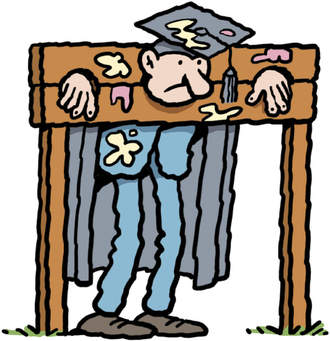
However, employing test results as metaphorical stocks-and-pillories for educators is as counter-productive to the education process as once was the humiliation of dunce caps for students, a long-abandoned practice now considered excessively harsh.

Further Reading @ The Prince George’s Sentinel

[The original commentary appeared in the now defunct Prince George’s Gazette in February 2015. The graphic is from tr.toonpool.com.]